Friday, November 9, 2012

LABYRINTHS


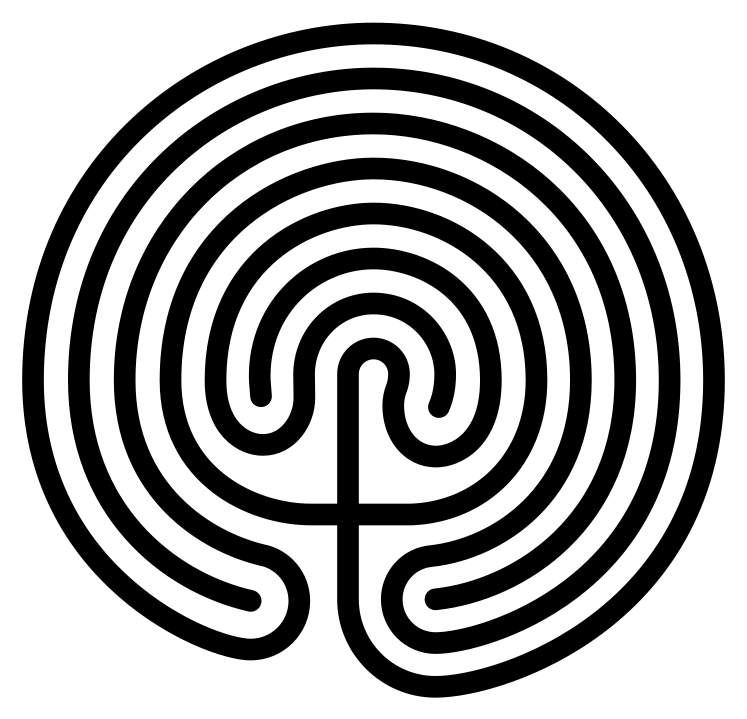
Classical labyrinths, as their names suggest, have remained unaltered in their geometric make up for hundreds if not thousands of years. I recently became interested in the construction of these mazes and how they relate to mathematics. However, I was surprised to see so few variations on what might me termed the classical labyrinth. To address this here are a number of different modes of construction. First the 4-fold construction;

And here with 5, 6 and 7-fold construction;


Next we have 8-fold labyrinth together with a hyper-dimensional theory of light (how did that get in there?). Notice how the 4, 5, 6, and 8-fold labyrinths all have but one centre while the 7-fold labyrinth has three, making it a far more difficult labyrinth to solve.


Finally there are what I refer to as hyperbolic labyrinths, which are really just the same things stretched in perspective.


 Do all n-fold labyrinths with prime numbers above 7 exhibit this multi-centred symmetry, or is it just 7? Post your answers below.

Sunday, October 28, 2012

MODULAR ELECTRON CONFIGURATION

All the World is a Series of Ties

When I was fourteen I learnt modular arithmetic at school. The examples we got seemed to come in a pattern. The answers were always 2,8,8, or 2,8,7 etc. This immediately got me thinking about the configuration of electrons in atomic shells. Perhaps, I thought, there was a connection between these two disciplines that would explain the mysterious pattern of the electron configuration once and for all. I later realised that there was no such link - at least not in the way I had envisaged. The relationship between the modular arithmetic examples and the electron configuration had been a mere coincidence (either that or whoever set the maths questions was trying to stimulate or impart some kind information).

At first I tried to reconfigure the Periodic Table so that the electrons count was based on remainder. This meant that a chemical reaction was balanced when the all of the elements summed to 0 (zero). Creating a table based on this method would make matching different stable reactions more easy. But it is hardly what you would call a breakthrough.

From here I went onto learn about the relationship between modular forms and elliptic curves. Elliptic curves sounded like they had more to do with the geometry of the election shells than did modular forms on their own, so I decided to investigate them further. At first I could not find out much about them, but then I watched a video about Fermat's Last Theorem and I saw that elliptic curves have more in common with the doughnut or torus shape than their name might otherwise suggest.

Modular forms and elliptical curves are useful in knot theory, because each individual knot can be expressed as one (and only one) modular form. This makes it easier for scientists and mathematicians to differentiate between very complex knot shapes. Many different kinds of knots can be depicted as windings around a torus or doughnut, and each of these is given a modular value like; 1,2 or 3,2 etc.

In this reproduction of my notes (click to enlarge) we can see the list of the periodic elements on the left, followed by their individual modular value and finally by the whole number elliptic curve value. As we can see H (hydrogen) is denoted by the number 1; meaning that it needs one electron to form a stable bond. Next we have Helium, which is stable and as such looks like a closed loop around the torus; See fig. 1 below.

Fig. 1; The closed loop around this torus represents the stable
electron configuration of Helium (Torus Knot: 1,2).

Lithium has three electrons, two of which are bonded and stable. The third loose electron is what makes this a highly reactive and to some extent unstable element. An elliptic representation of this element is as follows; (See fig. 2)

Fig. 2; This is the most common mathematical depiction of elliptic
curve geometry on the Internet. It shows a closed loop next to a 
line stretching off into infinity. The second line can also be thought of
as a loop because its ends meet at infinity. According to my theory
of electron configurations this is an accurate depiction of 
Lithium (Torus Knot: 1.5, 2).

Next we have Berilium. Berilium has four electrons and is therefore more or less stable. This could be depicted as two closed rings around the elliptic plane, but I believe a more accurate and fluid example is shown below in fig. 3.


Fig 3; Outer shell of Berilium
(Be; Mod 4, Torus Knot; 1, 2)
Fig 4: Outer shell of Oxygen
(O; Mod 0, Torus Knot 3,2)
Fig 4: Outer shell of Iron
(Fe; Mod 2, Torus Knot 4,2)


Fig 5; Outer shell of Nickel
(Ni; Mod 0, Torus Knot 5,2)

Next, lets take a look at how chemical bonds might be formed under this model. The example below (fig. 6) shows two Lithium atoms coming into close contact with one another. The two lines which represent the unbonded electrons begin to join energetically at infinity and draw one another closer together.


Fig 6; Two lithium atoms in close proximity.

Eventually they do join creating the well known form of the double torus (fig 7) to create 2Li.
Fig 7; 2 lithium atoms bonded.

It stands to reason that if a simple chemical bond like the one above (fig. 7) can take the form of a double torus, then a slightly more complex one, like 3 Aluminium atoms for example, might take the shape of a triple torus.

The triple torus shape is closely related to the Klein Quadratic, and many other automorphic linear groups that have a distinct relationship to the structure of time.
The toroidal electron configuration discussed in this paper  has been proven in some instances, most notably to do with high temperature superconductors.
However, there are important differences between my model and theirs. For instance, the PSI website depicts the electrons as discrete particles that follow their own individual paths around the toroid, whereas mine shows that the electrons all follow the same twisting path in the manner of a waveform. Waveforms (and therefore modular forms) are an important part of understanding electron shells, and should not be left out or forgotten.


From a structural point of view it is also important to note that the different electron shells, and therefore the different elliptic curves are nested one within the other, and that they share a common centre of symmetry with protons in the nucleus.


What the Modular theory of electron bonding and configuration tells us is that chemical bonding is akin to the knots of knot theory. Every knot has a unique modular form associated with it, known as its link compliment (or fundamental domain). These fundamental domains may be useful in building models of complex chemical compounds or reactions, and lead to the discovery of new kinds of materials in the future.

Thursday, April 12, 2012

NEW HORIZONS

In 4d Domain Connector I outlined an idea for 4-dimensional fundamental domains. A consequence of this type of 4D tiling is the observed expansion of space. Although I dubbed this tiling O'Neill space, in reality it is just the fabric of space-time understood from a different point of view. There are, however, a few direct consequences that derive from stating that space is expanding from 4th dimensional space. First off, it means that the rate of expansion is linked, in some way, to our perception and knowledge of what constitutes time itself. Second, it shows that time and space are orthogonal entities, existing at right angles to one another. Other speculations that I will address in this and later posts are;
  • There are no straight line accelerations in space-time, as viewed from outside the 4d reference frame
  • The expansion of space-time becomes negligible, or non-existent, at the speed of light
  • Time is not a spatial dimension with vector points other than those of 4d space
  • Rest mass is effectively a black hole singularity for 4d space

Imagine you are sitting on this train. When you look out the window you notice that objects in the foreground rush passed you at a seemingly greater speed than objects that are situated on the horizon. If we imagine that the motion of the train is equivalent to time, then we can say that the relative motion of the objects in the foreground constitute events passing us by, while the objects that appear frozen in the distance correspond to a 4d spatial vector point that is equivalent to the speed of light. These spacial vector points exist at right angles to the motion of the train, and are therefore 4 dimensional.

Now imagine that the landscape is tiled with a grid pattern, like the one above. This grid pattern is fixed relative to the motion of the train, but it is expanding out towards you from a point dubbed infinity on the horizon. This is the expansion of space that is happening orthogonally to the passage of time. It is driving the circular motion of time, just as water coming out of a right angled sprinkler nozzle drives the sprinkler around. Accelerating in space is equivalent to zooming out into the horizon where the trees and shrubs appear mostly static, thus achieving the relativistic effect of time dilation. If we imagine that our straight line track is actually the circumference of an infinitely large circle then we can legitimately bend our planar grid pattern into a circle (see below). The advantage of having a circular space-time diagram is so we can include the expansion of space from a central 4d point and still have all the characteristics of an ordinary Minkowskian diagram.

In Minkowskian Spacetime diagrams, time is shown on the vertical axis and space is shown on the horizontal axis. The radial space-time diagram has the time 'axis' for the entire 3d spatial realm around the circumference of the circle, while the spatial axis of the 4d realm goes off towards the centre. The whole diagram is rotating with time. Just like an ordinary wheel or merry-go-round the circumference of the circle is traveling much faster than the centre; indeed at the very centre we can say that no rotational motion (i.e. time) is taking place whatsoever. This means that the centre corresponds to the speed of light c and the horizon as viewed from our train.

If it were possible to build a spacecraft capable of traveling at the speed of light, it would depart from a point in spacetime at the outer periphery of the circle (green line) and travel inwards towards the centre (purple line). It would be traveling in a straight line away from this point, but the departure point is also moving around the circumference as time moves on. An outside observer, like ourselves, would see a curved trajectory; by virtue of what is known as the Coreolis effect. If the outsiders perspective exists, it means that there are no straight line accelerations extant anywhere in the Universe. Not even light could be thought of as traveling in straight lines; it would spiral towards different datums depending upon where the original parameters are set. The parametres are entirely movable so this paints the whole Universe as some kind of giant fractal whirligig.

Each time this radial space-time chart rotates it would wipe out or occlude data from an earlier time. The most obvious solution to this is some kind of 5d Riemann surface similar to Log z that extends indefinitely in the vertical axis. The central 'spine' of this structure denotes the speed of light.
By virtue of the fact that Riemann surfaces include both real and imaginary coordinates they give a much better picture of Einstein's equations beyond the speed of light. This is because superluminal  equations require solutions to the square root of a negative number, something which leads directly to imaginary numbers.

It has been speculated that at faster than light speeds time must begin to flow in reverse. However, from my understanding time is space expanding from the central spine at coordinate zero. Therefore, when you cross this impassable boundary point, the expansion of space would be coming from behind your trajectory; something which I don't believe would alter your perception of time or space very much, if indeed at all. Another example of a Riemann surface that could be useful is this one of the multi-valued cube root, or one such like it;

This image returns us to the concept that there exists two separate Universes side by side one another that interact to drive each other one, like an electromagnetic wave. See last post; Tumbling Toy Universe Theory for more on this.


Monday, March 26, 2012

TUMBLING TOY UNIVERSE THEORY


Cosmologists believe that there are three fundamental topologies (shapes) that the Universe could exhibit over time. These are; flat, positively curved, and negatively curved. All three of these models begin with a big bang singularity, but their ends are as different from one another as you might expect.

In the negatively curved model the expansion of the Universe continues until its very fabric can no longer contain the expansion, resulting in what is termed the Big Rip. In a closed positively curved Universe, the Universe expands from the Big Bang singularity and then begins to collapse again into what scientists term the Big Crunch. In a flat Universe, expansion levels out and the structural fabric of the Universe continues to exist forever while its internal processes eventually succumb to heat death.

Although most scientist believe that space is flat, or almost flat, there are a few theories that favor a positively curved (or closed) structure. Among these are the finite, fundamental domain Universe that we looked at in a recent post, and the Big Bounce theory. The latter theory suggests that the Big Bang that instigated our own Universe sprang from the Big Crunch of an even older incarnation. Studies of the quantum fluctuations between each of these singularities suggest that while the physical laws of each consecutive Universe will resemble each other on a fundamental level, no two Universes will ever be precisely the same.

As I have said, the Big Bounce theory relies on our Universe being positively curved overall. I think that this theory is the most interesting of the lot, but I have arrived at some conclusions which are at odds with the standard model. For one thing I propose that our Universe actually consists of two equally sized Universes existing side-by-side. When the topology of one of these Universes is positively curved, the topology of the other is negatively curved. In this way the two Universes are always completely symmetric. At regular intervals these Universes switch their respective Universes.

They are, in effect, playing leap frog with one another.

The analogy of the leap frog game is misleading however, because it implies (as I have done) that there is more than one player. You can't play leap frog by yourself anymore than you can jump over yourself. However, in our Universal model, the two Universes are connected in such a way as to be a single Universe. The closed curvature of one Universe is merely the reversed expression of the open curvature of its neighbour. And yet the two are inextricably interrelated just like the way the concave of a spoon on one side is the natural expression of the convex on the other.

The curious thing about this theory is what happens to the seemingly separate Universes as they cross form one topology into another. In the case of a formerly closed Universe that is reaching its end in a Big Crunch, it would erupt into a massive explosion that would expand outwards into its new incarnation as a negatively curved Universe. On the flip side the negatively curved Universe would be approaching its demise in a Big Rip, partially driven by the Big Crunch on the opposite side. As both of these processes reach their culmination the topology flips and the dying Universe becomes 'reincarnated' so to speak into a positively curved closed structure.

In the violent interim between these two periods, space would appear to have a topology that includes positively, negatively and flat structured Universes all at the same time, and at different scales. It seems to me that there is enough time in this interim period, as it last almost as long as any other period on the timeline, to warrant the existence of a third incarnation of a Universe. This would mean that another big bang/crunch would have to occur as the Universes transition from the interim period into either the closed or open state.


The whole concept can be further visualized with the use of the physics of tumbling toys. When gravity acts on these toys they flip end over end. This is a lot like the way the Universe flips from positive to negative curvature and back again. For this reason I have decided to dub this theory the Tumbling Toy Universe Theory.

It could be that the Big Bounce theory is the correct one, but that its motion and topology is in fact produced by a careful adherence to the mean of both Universes proposed in Tumbling Toy. In this case all of the world lines of this Universe would cross, resulting in a massive singularity.

From a Direct Relativity perspective we could suppose that the curvature/structure of the Universe is evolving over time. To begin with, at the early stages of the Big Bang the Universe had a closed structure, this quickly evolved into the 'more-than-likely' flat Universe we see today, and will eventually develop into the hyperbolic (or negatively curved) system. This is a further example of Direct Relativity (DR) in action, see posts; Direct RelativityStellar ObscuraWithin the Octonions. From a DR perspective this means that the Universe is accelerating (going from 0mph at the Big Bang, to light speed now, and superluminal speeds in the future) or it is rotating in some higher-dimension.

Saturday, March 24, 2012

SINGULARITY CONJECTURE


In this post I would like to offer a scientific conjecture towards the proof of the  existence of the singularity (technological or otherwise) through the use of hyperbolic geometry.

There are lots of examples of hyperbolic shapes on the internet, particularly of the crocheted kind, but not a lot of explanation as to what is meant by their curvilinear forms. In order to adequately visualise what is meant by these curves imagine you have a carpet that is cut too big for a room. You can lay the carpet out in the room but there will always be a certain amount of excess carpet  bulging up. If you try to flatten it out, by standing on it, the bulge travels to a different section of the room. The carpet would fit perfectly into this room in hyperbolic space, because hyperbolic space contains a greater number of degrees of freedom per area.

To think of it a different way imagine an ordinary vinyl record, which is a flat disc of 360º, with a warp in it. Just like with the carpet above no amount of flattening will get this warp out, because it will just be transferred to a different part of the record. The only way that this record would appear flat is if it was viewed from hyperbolic space where circles routinely have more than 360º of rotational freedom. Information is stored on vinyl in a series of pitted grooves. Obviously a record that has a greater number of degrees of rotation has a greater surface area, as well, and this means that it can contain much more information than an ordinary Euclidean record. From this observation we can deduce that an increase in dimensions is also equivalent to an increase in information.

If we agree that the Universe is approaching a singularity in which information and interconnectivity are increasing then we must also assume an increase in the number of hyperbolic dimensional symmetries therein. But if this is so, then why can't we perceive this increase directly?

The answer to this question may lie in the construction of the human brain. Hyperbolic curves appear in a number of different places in nature, for example in kelp seaweed, but they also appear inside and on the surface of the human brain. A baby is born with a relatively smooth surfaced brain, which gradually increases in hyperbolic curvature as more and more neural pathways are laid down. Again we see the correlation between the increase of information and interconnectivity with hyperbolic curvature. While our brains may become more convoluted as we age, the distortion of the brain mantel does not effect our sense of self to any great degree. This may be because although our minds are physically warping, they may simultaneously be increasing in hyperbolic symmetry, leading us not to perceive any distortion in our uniform sense of self or the Universe.

This concept appeals to me because I think that the human brain is capable of far more things than people, and modern day scientists, regularly give it credit for. There are numerous examples of telepathy and precognitive abilities among humans that could be explained by the idea that human consciousness is all interconnected via a higher-dimensional up-link of some kind. Abilities such as astral-projection and remote viewing could similarly have an explanation in the idea that both space-time and the human brain have an equivalent amount of warpage (i.e. considerable) allowing for the likely-hood of such fantastic things like wormholes, stargates and time warps to be much more common than first expected, and at the same time also directly related to the nature of mind.
Calabi Yau 10-dimensional manifold has curvature
similar to that of the human brain.

From this point of view the increasing curvature of the Universe as it moves towards the singularity is as much a result of human development and ingenuity as it is merely the evolution of the Universe itself. This suggests that in order to prevent the singularity from happening we, as a species, need to abstain from all worldly desires and pondering. Interestingly, this is not too far off what the Buddha taught and what many Eastern Yogis, Taoists and Native Americans believe. From experience I know that this abstention is what gives meaning and enlightenment in this world, i.e. the less we interact with the world on an egotistical level the more the world offers us in terms of incites and wonders. The contradiction here is that in discovering and compiling this knowledge I might be contributing, in whatever small way, to the likelihood of the singularity occurring.

If human consciousness is indeed the driving force behind the curvature of space then it must also be the responsible for the force known as dark energy, which is expanding the Universe. Dark energy is our increasing conscious experience of the world, while dark matter, I argue, is our enduring sense of self.

Tuesday, March 20, 2012

4d DOMAIN CONNECTOR

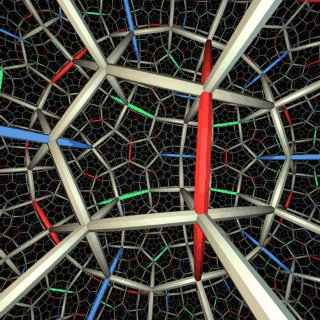
In this post I will outline my idea of a 4-dimensional link-compliments that are not of the Lobachevskian kind, but could be better termed as O'Neill Space. I suggest that this concept has great applications to the field of cosmology and will outline said applications in this and later posts. To begin though we need to a bit about modular forms, link compliments and Lobachevskian space.

3D Fundamental Domains and Lobachevskian Hyperbolic Space

There is a video on Youtube, called Not Knot, that goes some way to explaining the concept of fundamental domains of link compliments. Link compliments are any closed loop of string (or strings) that consist of any number of crossings. In the past, mathematicians had difficulty identifying if one link compliment was the same or different to another. But, by breaking down the loops into discreet sections called fundamental domains they can avoid this confusion by building a picture that is specific to each knot.
Note; To quickly visualize what is meant by a fundamental domain, think of a cube. When you flatten out its sides you get 6 squares in the shape of a cross. This is the fundamental domain of a cube. According to the video, there is only one fundamental domain for each link compliment making them very useful for identification purposes.

In the case of the Borromean Rings (as seen in this video) the looped sections are at right angles to one another and the fundamental domain is that of a cube. The domain is copied outside itself infinitely until it tiles all of 3-d space. 

By taking the fundamental domain of the Borromean Rings and adding a further 90º degrees to each axis we can make a dodecahedron that tiles all of space in a similar manner. This is called Lobachevskian hyperbolic space.


Modular forms such as these were imperative in solving Fermat's Last Theorem, but some mathematicians (like researcher Jeffrey Weeks) think that they may go even further by explaining the exact size and shape of the Universe itself. If correct, it would mean that the Universe is  finite in size, consisting of a single dodecahedron-like structure that is mirrored across space and time to give the illusion of an infinite universe. Our galaxy and everything else that is inside this fundamental domain would also be mirrored across space, resulting in an infinite number of copies of the Earth, you and me.


4D Fundamental Domains and O'Neill Hyberbolic Space

It baffles me why mathematicians have been content to chart the fundamental domains of 3-dimensional knots, but have neglected to investigate four dimensional ones. It seems to me that if you want to accurately create a picture of 4-dimensional space-time you would need a 4D fundamental domain.

In an infinite universe (whether it is repeated or not) giving your fundamental domain any specific size seems arbitrary. A 4D domain gets around this because all of its domains are free-scale. 

To create a four-dimensional fundamental domain we could begin by taking the order-2 domain of the Borromean rings and following each of the steps in the first video until we have created our 3D grid pattern stretching off into infinity. Then we can rotate this pattern around the 4th dimensional axis of the original cube until all of the domains that lie outside of the original cube domain now also lie inside of it. Obviously this would have to be repeated with each cube in the matrix (an infinite number of them), and then within each cube within each of those cubes (producing a far greater infinity). This mirroring would continue ad infinitum in a fractal manner.

Furthermore, each time a new cube is mirrored, it would alter the pattern relative to another domain, meaning that it in turn would need to be mirrored over again. This process, which would start off slowly at first would quickly escalate, as the 4D domain becomes more and more connected with itself. (See the next post The Singularity Conjecture for more on how this pertains to reality and the future).

Next, we have to understand what an infinitely tiled hyperbolic grid would look like and how it would sit in relation to the rest of the ordinary 3D grid. To do this you start by making a 2D grid of 9 squares (left) and invert it so that the central square lies on the outside, and the other 8 squares sit in place of the original central square (see below). Next, you make grid with 5x5 grid and invert it, then a 7x7 one and so on. Once you have mastered this you can begin to progress to a 3d grid structure, the inversion of which would be a hyperbolic grid.


However, just because you have mastered this does not mean that you can create a 4-d fundamental domain with ease. There are still many thought-processes and trials which must be taken. The apparent shape of one of these domains is a rhombicuboctohedron (see below), and which, oddly enough, is related to the dodecahedron of Weeks domain proposal;


However this object must exist inside a our original cube domain, with lines leading to each vertex, shown below;


These lines join to create the following number of shapes; 6 cubes, 8 tetrahedrons, and 12 triangular prisms. The rhombicuboctahedron can be rendered in the following topological manner;
These are three different angles of the same hyperbolic domain. The original domain looks something like this (see below);


The net of this form looks like this;


And finally the 4D domain looks like this;
In the infinite grid of cubes, the central cube that is our original domain is surrounded by 26 cubes. This block of cubes, which is also a cube, is further surrounded by a nest of 98 cubes, which is surrounded by 218 and so on. If we imagine that our original cube domain has a volume of 1 metre cubed then the next set would have 26mˆ3, then 98mˆ3 and so on. When all of this is rotated around the fourth dimensional axis, it is clear that space is becoming larger the closer you get to the centre.

This doesn't make any sense, the space is becoming larger on smaller scales, which ought to be measurable in some way. The reason why it isn't is because these domains lie for the most part stacked in the fourth dimension and a considerable amount of their bulk lies hidden there, only accessible to us through line of sight perspective. However, it is clear that this space wants to find room for itself in 3D space, and this need, it appears, is driving the expansion of the Universe.

O'Neill Space is unpacking itself from the fourth dimension. The entire Universe is exhibiting this unpacking in the form of expansion just as an object that is slowing down from a tremendous sub-luminal speed undergoes a length expansion. 

As each nested cube expands, cubes within those cubes being to expand so the whole process is exponential. Furthermore, because the tiling of the fourth dimensional fundamental domain is infinite, this unpacking will continue indefinitely. 

Perhaps even more phenomenal, is that this theory suggests that the fourth dimension is not time, as Relativists believe it to be, but rather ordinary space. The process of its unpacking from one dimension to another, however, does take place over time, and this means that if you travel fast enough you will undergo a length contraction taking you against this unpacking flow rate. Obviously the further you gain access into the hyperbolic grid structure of O'Neill Space the slower the unpacking appears. This could mean that the boundary between both spaces is something like the event horizon of a black hole; a point of no return for these cubes of space. Time is nothing more than the perceived rate at which fourth dimensional O'Neill space is unpacking into ordinary 3D space, in this writer's opinion. 

Note; There are three basic topologies for the Universe; positively curved, negatively curved and flat. According to the main proponent of the finite universe theory, Jeffrey Weeks, the existence of dark matter does not favor a negatively curved universe. This is strange, however, because the dodecahedron tiled space that he envisages is a Lobachevskian Hyperbolic and therefore negatively curved topology. There must be some explanation for this obvious disparity, but I cannot think what it might be.

Note; While space-time is known to be a 4-dimensional vector plane of 3 space and one time, its topology is not explained by the 4-dimensional algebra equations of the quaternions. The reason for this is that quaternions are only spatial and do not deal with time. For this reason some scientists have concluded that the 4th dimension is not time, but an added spatial dimension interacting with ours over time. Time, they believe, must be an extraneous principle acting over all dimensions. I would agree with this concept.


Wednesday, March 14, 2012

L4Y3R C4K3 TH30RY

Proposal for the Unification of Quantum Mechanics and Relativity.

Accelerating a massive object to the speed of light, if it were possible, would be equivalent to sending said object through a type of inter-dimensional Young's slit experiment, in which all of its de Broglie wavelengths would interfere with one another to create a holographic image that extends throughout time as well as space.
The wave-function would be vibrating in phase with time and would therefore appear completely static in this dimension - a proposal which conforms to the Relativistic Principle of time contraction. This theory, which I have dubbed Layer Cake Theory, attempts to unify the concepts of quantum weirdness and relativistic principles in an intuitive and lateral kind of way.

LAYER CAKE THEORY

Experiments involving the passing of a single photon through a double-slit grating, and the interference patterns that resulted from this, were influential in the formulation of the particle-wave duality theory of matter. Matter, like that which composes your body, is said to be made out of waves of probability. On a small scale the position/velocity of a particle becomes uncertain. But when enough of these particles are combined together, renormalisation occurs leading to the collapse of the wave-functions into a stable amount of what we call 'matter'.

In one of his lectures, the famous physicist Richard Feynman made reference to an experiment in which a stream of photons were fired at a detector behind a solid steel plate. Every now and then the detector would register a hit. The researchers concluded that the photon had taken a trajectory allowing it to swerve around the metal plate and hit the detector. This means that when looking at a single sub-atomic particle that comprises your body, for instance, we may find that its probability wave-function is looping out towards the stars... Such is the weirdness of quantum mechanics.

When an amount of matter begins to accelerate, I propose that some of its particles accelerate out from it at speeds which are, in a sense, greater than that of light speed. This because these particles are accelerating in the dimension of time and not of space; looping out towards the future. The faster an object travels the more particles it emits. These particles are actually space-time manifolds, slices of the original object that travel into the future at tremendous speeds. Each of the manifolds are holographic (fractal) replicas of the original object. This means that as the object accelerates and more and more of these manifolds are ejected, its aspect (apparent size) begins to shrink in agreement with the Lorentz contraction.

Its over-all mass, however, is not depleted because the fractally encoded manifolds are representations of how the object appears at any one instance of time, and therefor each of them contain fractal information of the current state of the mass of the object in respect to its reference frame. Combined manifolds do not increase the mass of an object either, meaning that the mass is a fractal component of the entire structure. When an object, like a person, is at rest, they are the result of all of their space-time manifolds interfering with one another, to become a coherent image of themselves at any one moment.

The history, past, present and future of an object can be represented by an almost infinite number of space-time manifolds. The collective manifolds are fractal, because at any one time they all collapse to form one whole.

In the case of a large object, like the planet Earth, each separate instance of time in the life of this object is a separate space-time manifold. Due to the length and complex history of planet Earth the combination of this set of space-time manifolds at anyone instance is enough to warp the fabric of space itself.

I have already made clear that, in the case of an accelerating object, the loss of space-time manifolds does not decrease the mass of the entire object. So, I would appear to be contradicting myself by suggesting that the accruement of manifolds would lead to increased mass. But, again this is really not the case. It is true that larger objects of a similar density have more mass, but they also have a greater number of manifolds. This suggests that, on average, mass is equivalent to longevity. The more massive a body, the more manifolds it contains and the further these manifolds extend in 4-d space-time.


Again this is something that we also see on a more manageable scale with animals. For instance it has been suggested that elephants and mice have the same amount of heart beats (close to a billion) in their lifetime. But, in the case of the mouse, they are just happening at a far more rapid scale than when compared to the elephant. LCT would suggests that the reason for this is to do with the relationship between total body mass and longevity, although exceptions are sure to apply in the case of living animals, where so many variables exist.

Traditionally physicists have had a hard time marrying the concepts of Special and General Relativity with the weirdness of Quantum Mechanics. Layer Cake Theory (LCT) attempts to address this disparity and it does so in a very unexpected manner, by supposing that a massive object traveling at the speed of light is essentially equivalent to a particle that travels through a double slit grating. While the latter generates an energetic wave of probabilities stretching across space, the former is comprised of a highly energetic 4-dimensional probabilistic wave-form that stretches across time. A comparison between both Quantum Mechanics and Relativity, according to LTC is as follows;

Quantum Mechanics                                                   Relativity


Wave-particle duality                                                   Matter/mass accelerating towards
(as expressed by Young Slits experiment)                the speed of light.


the same particle/space being in two                       The same temporal instance being
or more different places at once                                being in two or more different instances


The accretion of matter/atoms creating                   The accretion of space-time manifolds
the renormalistion of quantum uncertainty              creating stable time